One of the Greatest WWII Movies of All Time Is Waiting To Be Rediscovered on Prime Video
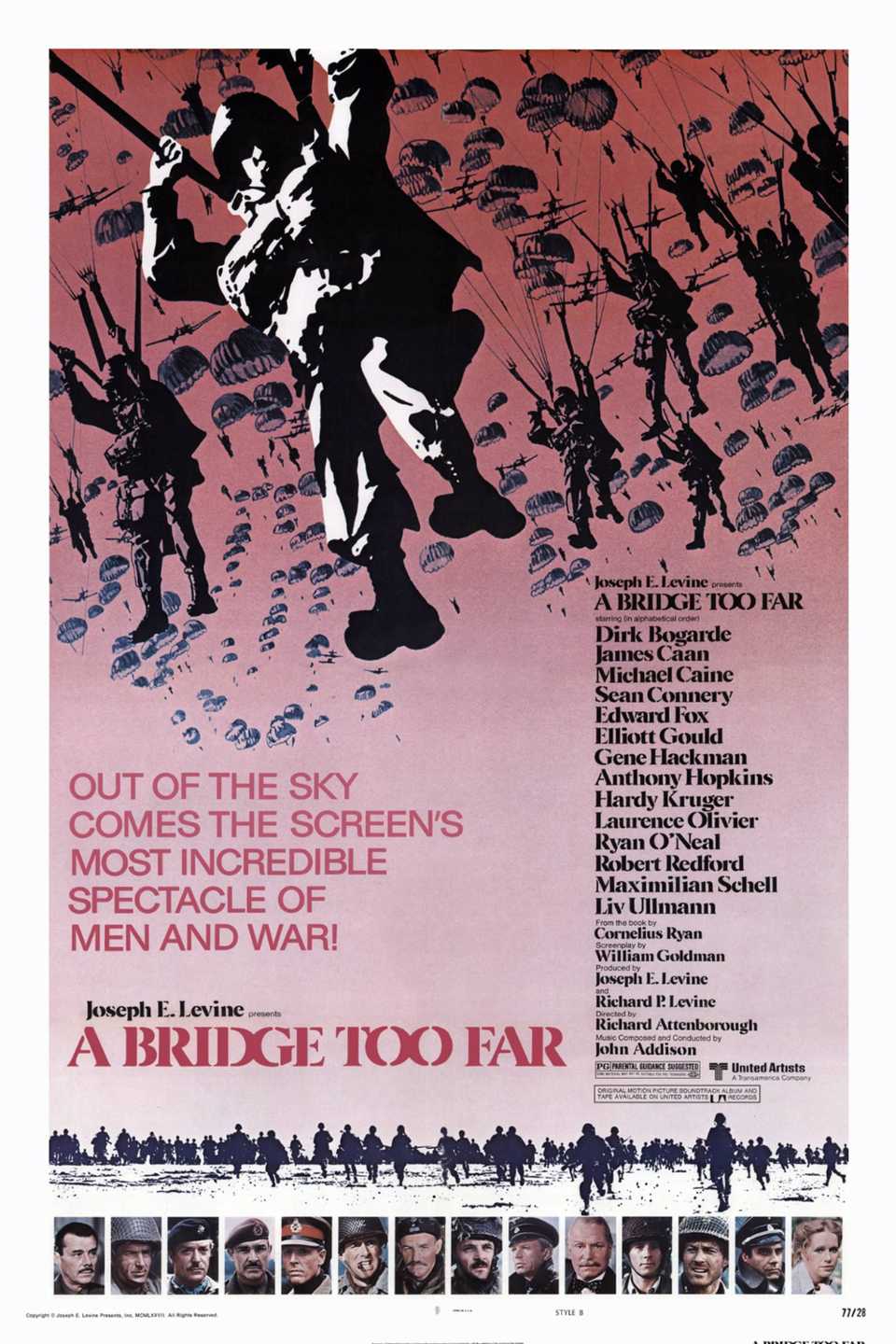
The best World War II movies of the last century typically feature heroic stories of battle and conquest, survival despite insurmountable challenges, and honorable figures fighting against injustice. And it's no surprise that Richard Attenborough's 1977 war drama A Bridge Too Far stands out as one of the most realistic and ambitious World War II films ever made, and now it's streaming on Prime Video. Upon its release, however, it was not universally lauded. In his scathing review, Roger Ebert asks, "Why make a movie about total defeat and stupidity?" And yet, that is the reason why A Bridge Too Far stands out among the rest. The film captures the scale, complexity, and failure of an operation by the Allied forces to surprise their enemies.
A Bridge Too Far did not match the success of Steven Spielberg's seminal classic SavingPrivate Ryan, but its epic storytelling, nuanced perspectives, and historical authenticity ensure its place among the greats. It's an unapologetic tale of the triumphs and failures of war with a commitment to depicting war's horrors. These are portrayed by a massive ensemble cast of A-list stars of its time, drawn from Europe and the United States. And now you can watch it for free on Tubi.
'A Bridge Too Far' Is Based on the True Story of the Allied Forces' Botched Operation
Adapted from historian Cornelius Ryan's book of the same name, A Bridge Too Far is about the Allied forces' ambitious, ill-fated Operation Market Garden, a plan designed to end World War II by capturing key bridges in the Nazi-occupied Netherlands. Executed in September 1944, the operation was the largest airborne assault in history, with 35,000 soldiers being flown from England and dropped behind enemy lines. Attenborough's picture faithfully reconstructs this strategy through three main perspectives: the Allied forces, comprising the British, American, Dutch, and Polish paratroopers; Dutch civilians; and German soldiers. The film is an interplay of hope and chaos in war. The confidence of the military generals led by the British General Montgomery fails to align with the realities of those on the frontlines. William Goldman's screenplay highlights how these top soldiers ignored intelligence and underrated their opponents, leading to the total disaster that Roger Ebert terms "stupidity."
Collider Exclusive · Oscar Best Picture Quiz
Which Oscar Best Picture
Is Your Perfect Movie?
Parasite · Everything Everywhere · Oppenheimer · Birdman · No Country
Five Oscar Best Picture winners. Five completely different visions of what cinema can be — and what it can do to you. One of them is the film that was made for the way your mind works. Ten questions will figure out which one.
🪜Parasite
🌀Everything Everywhere
☢️Oppenheimer
🐦Birdman
🪙No Country for Old Men
FIND YOUR FILM →
01
What kind of film experience do you actually want?
The best movies don't just entertain — they leave something behind.
ASomething that pulls the rug out — that makes me think I'm watching one kind of film and then reveals I'm watching another entirely.
BSomething overwhelming — funny, sad, absurd, and genuinely moving, all at once.
CSomething grand and weighty — a film that makes me feel the full scale of what I'm watching.
DSomething formally daring — a film that pushes what cinema can even do.
ESomething lean and relentless — pure tension with no wasted frame.
NEXT QUESTION →
02
Which idea grabs you most in a film?
Great films are driven by a central obsession. What's yours?
AClass, inequality, and what people are willing to do when desperation meets opportunity.
BIdentity, family, and the chaos of trying to hold your life together when everything is falling apart.
CGenius, moral responsibility, and the catastrophic weight of a decision you can never take back.
DEgo, legacy, and the terror of becoming irrelevant while you're still alive to watch it happen.
EEvil, chance, and whether moral order actually exists or if we just tell ourselves it does.
NEXT QUESTION →
03
How do you like your story told?
Form is content. The way a story is shaped changes what it means.
AGenre-twisting — I want it to start in one lane and migrate into something completely different.
BMaximalist and genre-blending — comedy, action, drama, sci-fi, all in one ride.
CEpic and non-linear — cutting between timelines, building a mosaic of cause and consequence.
DA single unbroken flow — I want to feel like I'm living it in real time, no cuts to safety.
ESpare and precise — every scene doing exactly what it needs to do and nothing more.
NEXT QUESTION →
04
What makes a truly great antagonist?
The opposition defines the protagonist. What kind of opposition fascinates you?
AA system — invisible, structural, and almost impossible to fight because it has no single face.
BThe self — the ways we sabotage, abandon, and fail the people we love most.
CHistory — the unstoppable momentum of events that no single person can stop or redirect.
DThe industry — the machinery of culture that chews up talent and spits out irrelevance.
EPure, implacable evil — a force so certain of itself it becomes almost philosophical.
NEXT QUESTION →
05
What do you want from a film's ending?
The final note is the one that lingers. What do you want it to sound like?
AShock and inevitability — a conclusion that recontextualises everything that came before it.
BEarned emotion — I want to cry, laugh, and feel genuinely hopeful, even if the world is a mess.
CDevastation and grandeur — an ending that makes me sit in silence for a few minutes after.
DAmbiguity — something that leaves enough open that I'm still thinking about it days later.
EBleakness — an honest refusal to pretend the world is tidier than it actually is.
NEXT QUESTION →
06
Which setting pulls you in most?
Where a film takes place shapes everything — mood, stakes, what's even possible.
AA gleaming modern city with a hidden underside — beauty masking rot, wealth masking desperation.
BA collapsing suburban life that opens onto something infinite — the multiverse of a single ordinary person.
CThe corridors of power and science at a world-historical turning point — where decisions echo for decades.
DThe grimy, alive chaos of New York and Hollywood — fame as both destination and trap.
EVast, indifferent landscape — desert and highway where violence arrives without warning or reason.
NEXT QUESTION →
07
What cinematic craft impresses you most?
Every great film has a signature — a technical or artistic element that makes it unmistakable.
AProduction design and mise-en-scène — every frame composed to carry meaning beneath the surface.
BEditing and tonal control — the ability to move between registers without losing the audience.
CScore and sound design — music that becomes inseparable from the dread and awe of what you're watching.
DCinematography as performance — the camera not recording events but participating in them.
ESilence and restraint — what's left unsaid and unshown doing more work than any dialogue could.
NEXT QUESTION →
08
What kind of main character do you root for?
The protagonist is the lens. Who you choose to follow says something about you.
ASomeone smart and resourceful who makes increasingly dangerous decisions under pressure.
BSomeone overwhelmed and ordinary who turns out to be capable of something extraordinary.
CA brilliant, tortured figure whose gifts and flaws are inseparable from each other.
DA self-destructive artist whose ego is both their superpower and their undoing.
EA quiet, principled person trying to make sense of a world that has stopped making sense.
NEXT QUESTION →
09
How do you feel about a film that takes its time?
Pace is a choice. Some films sprint; others let tension accumulate slowly, deliberately.
AI love a slow build when I know the payoff is going to be seismic — patience for a devastating reveal.
BGive me relentless momentum — I want to feel breathless and emotionally spent by the end.
CEpic runtime doesn't scare me — if the material demands three hours, give me three hours.
DI want it to feel propulsive even when nothing is technically happening — restless energy throughout.
EDeliberate and unhurried — I want dread to accumulate in the spaces between the action.
NEXT QUESTION →
10
What do you want to feel walking out of the cinema?
The best films leave a mark. What kind of mark do you want?
AUnsettled — like I've just seen something I can't fully explain but can't stop thinking about.
BMoved and energised — like the film reminded me what actually matters and gave me something to hold onto.
CHumbled — like I've been in the presence of something genuinely important and overwhelming.
DExhilarated — like I've just seen cinema doing something it's never quite done before.
EHaunted — like a cold, quiet dread that stays with me for days.
REVEAL MY FILM →
The Academy Has Decided
Your Perfect Film Is…
Your answers have pointed to one Oscar Best Picture winner above all others. This is the film that was made for the way your mind works.
Parasite
You are drawn to films that operate on multiple levels simultaneously — that begin in one genre and quietly, brilliantly migrate into another. Bong Joon-ho's Parasite is a film about class, desire, and the architecture of inequality that manages to be darkly funny, deeply suspenseful, and genuinely shocking across a single extraordinary running time. Your instinct is for cinema that hides its true intentions until the moment it's ready to reveal them. Parasite is exactly that — a film that rewards close attention and punishes assumptions, right up to its devastating final image.
Everything Everywhere All at Once
You want it all — and this film gives you all of it. The Daniels' Everything Everywhere All at Once is one of the most maximalist films ever made: action comedy, multiverse sci-fi, family drama, existential crisis, and a genuinely earned emotional core that sneaks up on you amid the chaos. You are someone who responds to ambition, who doesn't want cinema to choose between being entertaining and being meaningful. This film refuses that choice entirely. It is overwhelming by design, and its overwhelming nature is precisely the point — because the feeling of being crushed by infinite possibility is exactly what it's about.
Oppenheimer
You are drawn to cinema on a grand scale — films that understand history not as a backdrop but as a force, and that place their characters inside that force and watch what happens. Christopher Nolan's Oppenheimer is a film about the terrifying gap between what we can do and what we should do, told with the full weight of one of the most consequential moments in human history behind it. You want your films to feel important without feeling self-important — to earn their ambition through sheer craft and the gravity of their subject. Oppenheimer does exactly that. It is enormous, complicated, and refuses easy comfort.
Birdman
You are drawn to films that foreground their own construction — that make the how of the filmmaking part of the what it's about. Alejandro González Iñárritu's Birdman, shot to appear as a single continuous take, is cinema examining itself through the cracked mirror of a fading actor's ego. You respond to formal daring, to the feeling that a film is doing something that probably shouldn't be possible. Michael Keaton's performance and Emmanuel Lubezki's restless camera create something genuinely unlike anything else — a film that is simultaneously about creativity, relevance, self-destruction, and the impossibility of ever truly knowing if your work means anything at all.
No Country for Old Men
You are drawn to cinema that trusts silence, that refuses to explain itself, and that treats dread as a form of meaning. The Coen Brothers' No Country for Old Men is a film about the arrival of a new kind of evil — implacable, arbitrary, and utterly indifferent to the moral frameworks we use to make sense of the world. It is one of the most formally controlled films ever made, and its controlled restraint is what makes it so terrifying. You want your films to haunt you, not comfort you. You are not interested in resolution if resolution would be dishonest. No Country for Old Men is honest in a way that most cinema never dares to be.
↻ RETAKE THE QUIZ
With a star-studded ensemble cast that mirrors the film's sprawling narrative, including Sean Connery, Michael Caine, Robert Redford, Anthony Hopkins, and Gene Hackman, A Bridge Too Far is ahistory class that shows that war is not only horrific for soldiers but also takes a toll on civilians as well. For instance, a moment in the movie shows a woman going about her business when she suddenly has unexpected soldiers as guests, with one telling her, "I'm awfully sorry, but I'm afraid we're going to have to occupy your house." Other scenes depict civilians caught in the line of fire, as well as the carnage of soldiers on the ground. It's unflinching in its portrayal of war, with graphic images that leave an impression. Upon its release, it had to be edited in some destinations before being screened.
'A Bridge Too Far' Is a Cinematic Triumph Despite Its Flaws
Filmed on location in the Netherlands, A Bridge Too Far is a visual triumph that succeeds in part due to its effort at being authentic. Germans speak German, the Dutch speak Dutch, and even the Americans and the British are distinct in their speeches and accents (including Sean Connery in his Scottish accent). Attenborough’s attention to detail, like having tens of airplanes in the sky and thousands of parachutes with stuntmen dropping, makes the film breathtaking. While it has been criticized for some of its aged, bland effects, the battle sequences are gritty and immersive. In its near-three-hour length, criticized by some, it transports you to the chaos of the battlefield. This realism wasn't lost on veterans and critics alike, many of whom praised its accurate portrayal of the operation's scale and its complexity.
Comparable to Christopher Nolan's Dunkirk, the film rarely gives the impression of a central character leading the plot. A Bridge Too Far eschews traditional lead characters for ensemble storytelling that reflects the collective effort and sacrifice of war. General Montgomery, who developed the strategy, for instance, is a physically absent character in the film. Each of the many other characters seems to be fighting individual wars that only converge on the bigger war at hand. However, unlike Dunkirk, which condenses its narrative into a tense and focused runtime, A Bridge Too Far is focused on the failed operation's epic scale. This approach, while it may not be emotionally stimulating, depicts the rawness of war itself.
Decades after its release, A Bridge Too Far demands patience but rewards viewers with an unparalleled depiction of WWII's triumphs and tragedies. It’s a film that doesn’t glorify war but instead captures its chaos, futility, and humanity. If you are a fan of sprawling combat, this is definitely your movie.
Release Date
June 15, 1977
Runtime
175 Minutes